UX Design
AI Delegation Matrix
Feb 21, 2026
I’ve seen a recurring pattern many time: we tend to treat AI as a "feature" to be added, rather than a fundamental shift in task ownership. In my recent projects, I’ve started applying the AI Delegation Matrix a framework that moves us past the "chatbox everywhere" phase and forces us to ask: Should this UI even exist?
The Framework: Who Holds the Steering Wheel?
The Matrix categorizes every interaction into three modes based on two variables: Automation Suitability (risk and reversibility) and Automation ROI (frequency and data readiness).
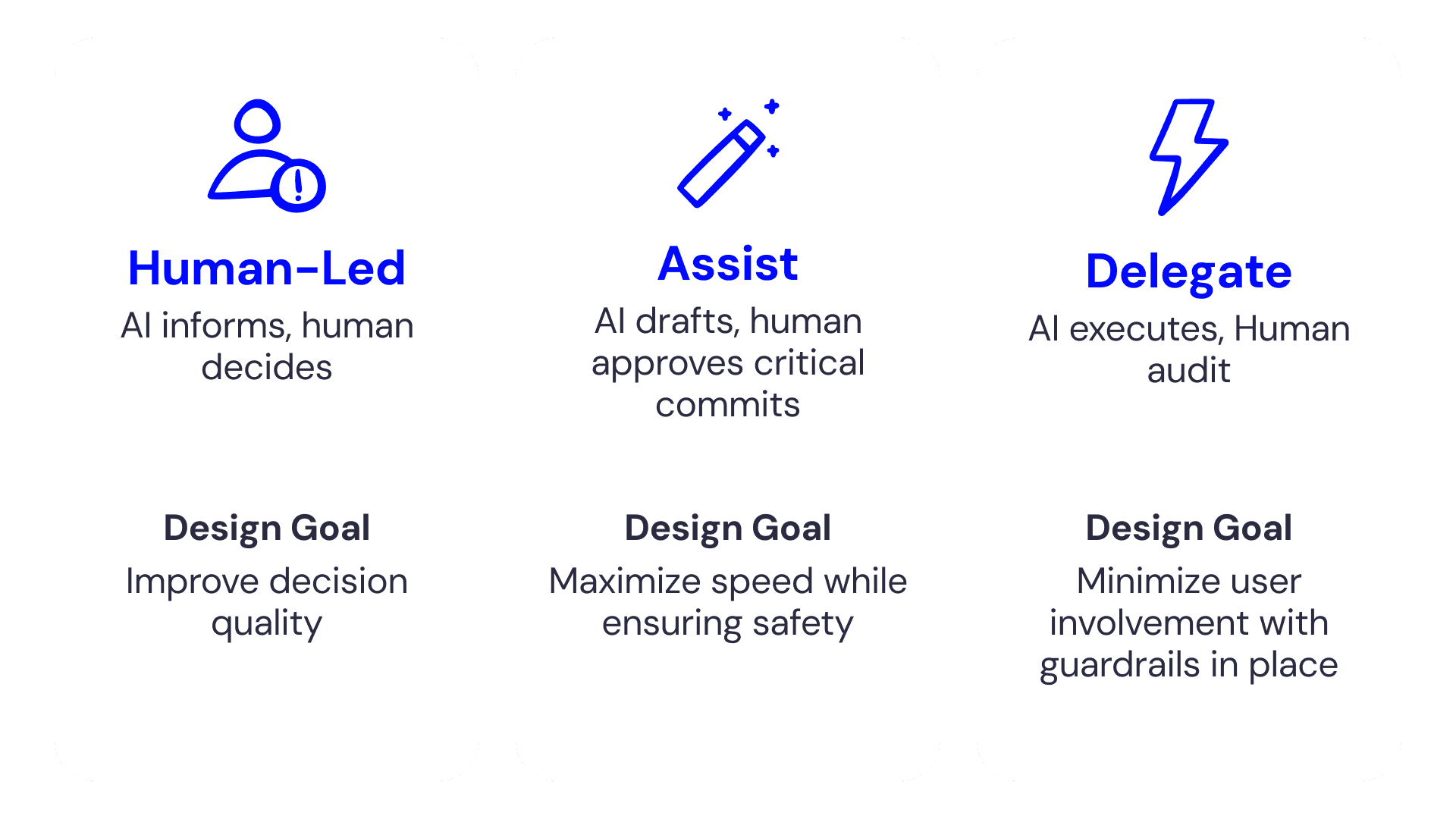
1. The "Delegate" Mode (Invisible UI)
This is where the most radical UX shifts happen. If a task is high-volume but low-risk (like data normalization or meeting scheduling), the best UI is often no UI.
Practical Implementation: Move away from manual forms. Instead, design Audit Views and Activity Logs. The user shouldn't click "Save"; they should receive a notification that the work is done, with a clear "Undo" or "Rollback" option.
Benefit: Complete removal of cognitive load for repetitive tasks.
2. The "Assist" Mode (The Human Handshake)
For tasks that are high-leverage but risky - like writing code or approving a large payment - AI acts as the heavy lifter, but the human remains the signatory.
Practical Implementation: Use Draft-first flows. Don’t show a blank state; show a generated suggestion. Implement Diff-based reviews (similar to GitHub) so users can see exactly what the AI changed versus the original state.
Benefit: Massive speed gains without losing accountability. It turns the user from a "creator" into an "editor."
3. Human-Led" Mode (The Guarded Zone)
Some things shouldn't be automated. High-stakes decisions involving ethics, empathy, or complex strategy (like a performance review or a pivot in product direction) belong here.
Practical Implementation: Here, AI’s job is to provide Evidence Packs. Instead of suggesting an answer, the UI should surface relevant facts, cite sources, and frame tradeoffs to help the human make a better-informed decision.
Benefit: Protects the integrity of high-stakes outcomes while reducing the "research fatigue" that usually precedes them.
Moving from Theory to Shipping
When I’m auditing a complex platform, I use a simple 6-step process:
Map the Workflows: List every "Verb + Object" (e.g., "Triage Ticket").
Identify Commit Points: Where does the action become "real" or permanent?
Score for Risk: Is it reversible? What is the "blast radius" of a mistake?
Assign the Mode: Plot it on the matrix.
Design for the Mode: Stop using generic patterns. If it's Delegate, design for monitoring. If it's Assist, design for correction.
Gate with Metrics: Monitor how often users "undo" or "edit" AI suggestions to move tasks from Assist to Delegate over time.
Why This Matters
The "messy middle" of AI design happens when we give AI too much control over risky tasks or too little control over boring ones. By using the Delegation Matrix, we stop designing tools and start designing collaborative systems.
Our goal as designers is no longer just to reduce friction, it’s to intelligently distribute agency. The most sophisticated UI of the future might just be the one that disappears because the AI finally earned the right to be delegated to.
Source: AI Delegation Matrix